When can I apply?
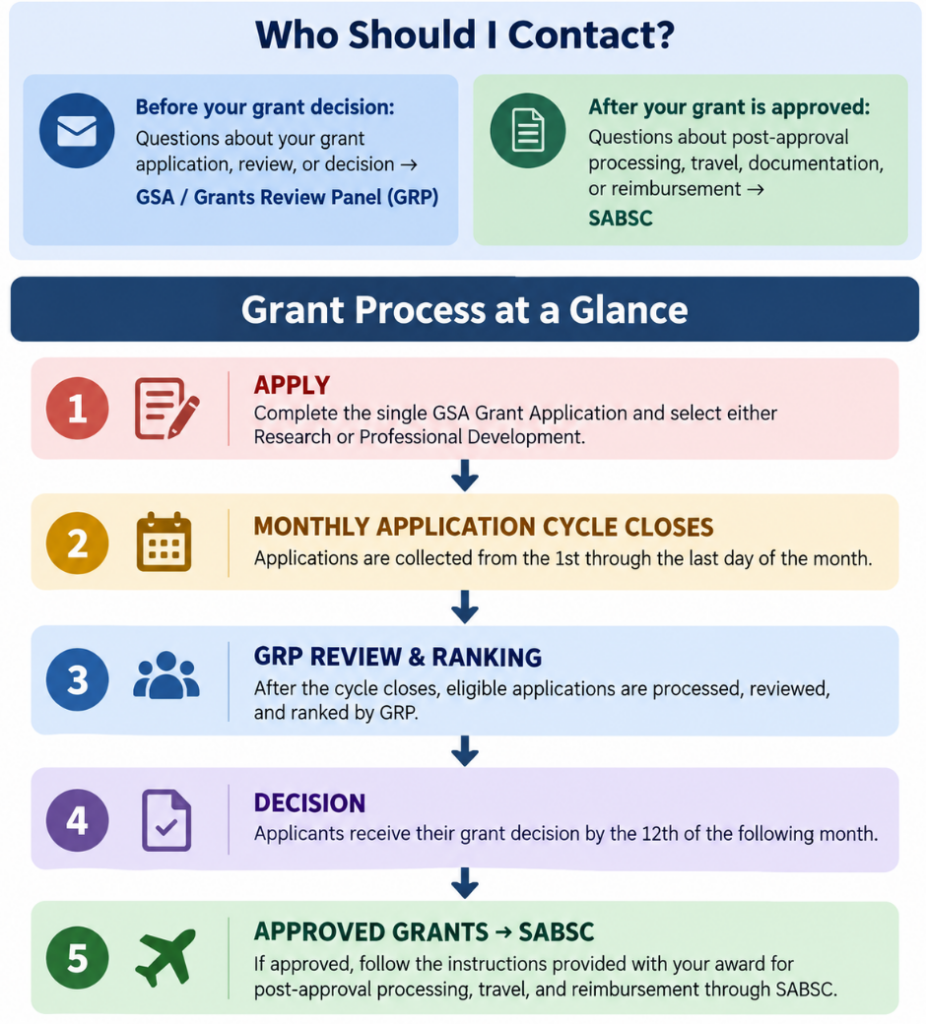
Applications are accepted every month.
Each grant cycle runs from the 1st through the last day of the month.
| Application Opens | 1st of the month |
| Application Closes | Last day of the month |
| Decision Notification | By the 12th of the following month |
| Travel Applications | May be submitted up to 180 days before travel be be considered in the cycle. |
Example
If you submit your application anytime between September 1 and September 30, your application will be part of the September grant cycle.
Applications will be processed and reviewed after the September cycle closes, and you will receive your decision by October 12.
Planning to Travel?
You may apply for eligible travel up to 180 days before your travel date.
Please plan ahead and select an application cycle that provides enough time for both the GSA review process and any required post-approval travel processing.
You will receive your decision by the 12th of the following month.
Applications are not reviewed on a rolling basis.
Applications remain open through the last day of each month. Once the cycle closes, we process applications and send them to the Grants Review Panel Committee (GRP) for review and ranking.
Please do not expect a decision before the stated notification date.
Submitting earlier in the month does not mean that your application will be reviewed earlier.
For example:
Application submitted September 3 → Decision by October 12
Application submitted September 28 → Decision by October 12
Both applications are part of the same September grant cycle and are reviewed after that cycle closes.
There is no advantage or disadvantage to submitting earlier within the same monthly cycle.
Meeting the eligibility requirements does not guarantee funding.
GSA has limited grant funding available. The Grants Review Panel (GRP) reviews eligible applications using standardized criteria and ranks them within each grant cycle.
When the total amount requested by qualified applicants exceeds the funds available, higher-ranked applications receive priority for funding.
When reviewing your Research Grant application, GRP wants to understand:
- What are you working on? Clearly explain your research and what you are requesting funding for. Your explanation should be understandable to reviewers who may not be in your field.
- Why do you need this funding? Explain how the requested funding will help move your research forward and what may be difficult or impossible to complete without it.
- Where are you in your research? Tell us whether the request supports early research, ongoing data collection, a thesis/dissertation milestone, final experiments, graduation, or another important stage of your degree.
- What will you accomplish? Explain what you expect to complete with the funding, such as experiments, data collection or analysis, access to specialized resources, or progress toward your thesis/dissertation.
- Can UMBC resources be used? If the equipment, facility, analysis, service, or other resource you need is available at UMBC, consider whether you can use it for your project. If you need to use an outside resource instead, tell us why. The UMBC resource may, for example, lack the required capability, be unavailable within your research timeline, or not be appropriate for your specific work.
- What will the funding cover? Provide a clear and reasonable budget and explain how the requested expenses support your research.
- Do you have other funding available? Tell us about relevant advisor, department, program, research, or external support and explain what funding gap remains.
Master’s and doctoral students are not prioritized based on degree type alone. GRP considers where you are in your individual research and how important the proposed funding is to your progress.
Meeting the eligibility requirements does not guarantee funding.
GSA has limited grant funding available. The Grants Review Panel (GRP) reviews eligible applications using standardized criteria and ranks them within each grant cycle.
When the total amount requested by qualified applicants exceeds the funds available, higher-ranked applications receive priority for funding.
When reviewing your Professional Development Grant application, GRP wants to understand:
- Why is this opportunity important to you? Explain why this particular conference, workshop, training, professional event, or other opportunity is valuable to your development.
- How will you participate? Tell us whether you will present, attend a workshop or training, participate on a panel, compete, network, or otherwise actively engage in the opportunity.
- How does it connect to your goals? Explain how the experience supports your academic, research, career, or professional goals.
- Why is this opportunity valuable at this point in your graduate career? For example, it may support your research development, thesis/dissertation work, career preparation, graduation, job or postdoctoral search, or another professional milestone.
- What do you expect to gain? Be specific about the skills, connections, exposure, training, feedback, or other outcomes you expect from participating.
- What will the funding cover? Provide a clear and reasonable budget for the expenses for which you are requesting support.
- Do you have other funding available? Tell us about relevant department, advisor, conference, program, or external support and explain what funding gap remains.
You do not need to present for your application to be competitive. Presenting is one form of meaningful engagement, but GRP considers the overall value and relevance of the opportunity to each applicant.
GRP uses both evaluation and ranking when making funding decisions.
GRP reviews each eligible application using the standardized rubric. GRP then ranks applications relative to other eligible applications in the same grant cycle.
Because GSA grant funds are limited, there may be cycles where the number or total value of strong applications exceeds the funding available.
Depending on the strength of your application, its ranking, eligible expenses, and available GSA funding, an application may receive:
- Full funding
- Partial funding
- No funding
A strong or eligible application therefore does not automatically guarantee an award.
The best way to help GRP evaluate your application is to be clear, specific, and complete. Do not assume reviewers know why a conference, experiment, instrument, facility, or opportunity is important to you. Explain how it supports your individual goals and progress.
The GSA grant academic year runs from July 1 through June 30.
Reviewers consider previous GSA grant support to distribute limited grant funding opportunities more equitably across the graduate student community.
No previous GSA grants during the academic year: Eligible to apply.
One previous GSA grant during the academic year: Eligible to apply for a second grant.
Two previous GSA grants during the academic year: Not eligible for an additional GSA grant.
Grant eligibility resets on July 1.
The Grants Review Panel (GRP) reviews applications and makes grant funding decisions.
Once your GSA grant is approved, SABSC will handle the next steps for grant processing, travel, and reimbursement.
For more information: SABSC Process
Your grant approval notification will provide information about your next steps.
Please remember: Grant approval and reimbursement are separate processes.
Receiving an approval from GRP means that GSA has approved your grant award. You must still complete the applicable post-award, travel, and reimbursement requirements.